Full-Spectrum vs Far-Infrared Saunas: Which Wavelengths Matter and Why
By Telos Wellness Editorial Team. Last reviewed 2026-06-01.
A full-spectrum infrared sauna emits near, mid and far-infrared (0.76-1000 µm) from a combination of carbon panels and halogen lamps; a far-infrared sauna emits only the FIR band from carbon or ceramic emitters. UK full-spectrum cabins typically cost £700-£2,000 more. The clinical evidence base (Beever 2009 and Hussain & Cohen 2018) refers chiefly to far-infrared cabins; near-infrared adds a separate photobiomodulation mechanism with cabin-specific evidence still limited.
What "far-infrared" and "full-spectrum" mean
Full-spectrum infrared refers to a sauna cabin that emits across all three infrared bands: near (0.76-1.4 µm), mid (1.4-3 µm) and far (3-1000 µm). The near-infrared component is produced by halogen lamps, the far-infrared by carbon panels. Full-spectrum cabins are sold at a £700-£2,000 UK premium over far-infrared-only models. The additional near-infrared component delivers photobiomodulation, a mechanism distinct from the heat-stress response delivered by far-infrared (Patrick & Johnson, 2021) [4].
Wavelength range, FIR 3-1000 µm
Far-infrared spans 3-1000 µm of the electromagnetic spectrum. It is generated by carbon panels operating at moderate surface temperatures of 90-110°C, or by ceramic rods at higher surface temperatures of 250-350°C. FIR is absorbed almost entirely within the outer 1 mm of skin, and the documented cardiovascular and pain-related sauna outcomes derive from the heat-stress response that follows from this surface absorption (Hussain & Cohen, 2018) [1]; Beever 2009 reviews the FIR-specific cardiovascular data (Beever, 2009) [2].
Wavelength range, full-spectrum NIR + MIR + FIR
Full-spectrum coverage adds near-infrared (0.76-1.4 µm) and mid-infrared (1.4-3 µm) to the FIR base. The NIR component is the substantive functional addition: it is produced by halogen lamps and is the only sub-region of the infrared spectrum that activates photobiomodulation via mitochondrial cytochrome c oxidase. The MIR content is largely a by-product of the halogen lamp's spectral tail and the higher-temperature operation of any ceramic emitters fitted alongside the carbon panels.
Heater technology behind each format
The format distinction maps directly onto heater hardware. The wavelength a cabin emits is fixed by the surface temperature and material of its emitters; no software setting can change this, regardless of marketing copy.
Carbon and ceramic emitters (FIR)
Carbon panels emit broad-band FIR at low surface temperatures, distributing radiant energy across a large emitter area. Ceramic rods emit FIR with some MIR content from a small high-temperature surface, concentrating radiant energy onto a narrower section of the user's body. Both technologies are FIR-only emitters; neither produces meaningful NIR. UK cabins frequently combine carbon panels for the principal heat load with smaller ceramic auxiliary heaters in the calf or lumbar regions.
Halogen lamps (NIR)
Halogen lamps are the NIR source in full-spectrum cabins. They are filament-based bulbs operating at high filament temperatures (approximately 2,800°C) which shifts the emission peak into the NIR band centred near 1.1 µm. A visible-red component is incidental to the NIR output and is not the therapeutic content. Halogen NIR lamps differ from the infrared incandescent bulbs sometimes sold for localised warming applications: the lamp specifications used in cabin NIR modules are matched to the photobiomodulation literature on dose and exposure rather than to simple radiant heating.
What each wavelength does to the body
Heat-stress and photobiomodulation are distinct mechanisms with different evidence bases. A buyer evaluating a full-spectrum premium against a FIR-only baseline should map each marketed benefit onto its underlying mechanism before comparing the £-cost of the two formats.
Far-infrared, heat-stress response
FIR exposure raises skin temperature, conducts inward to underlying tissue and drives core body temperature toward the 38-38.5°C heat-stress threshold. The cascade of physiological adjustments (peripheral vasodilation, raised heart rate to 100-150 bpm, plasma-volume shift, sweating) is the basis of the documented cardiovascular outcomes in Beever 2009 and the pain and recovery outcomes in Hussain & Cohen 2018 (Hussain & Cohen, 2018) [1].
Near-infrared, photobiomodulation
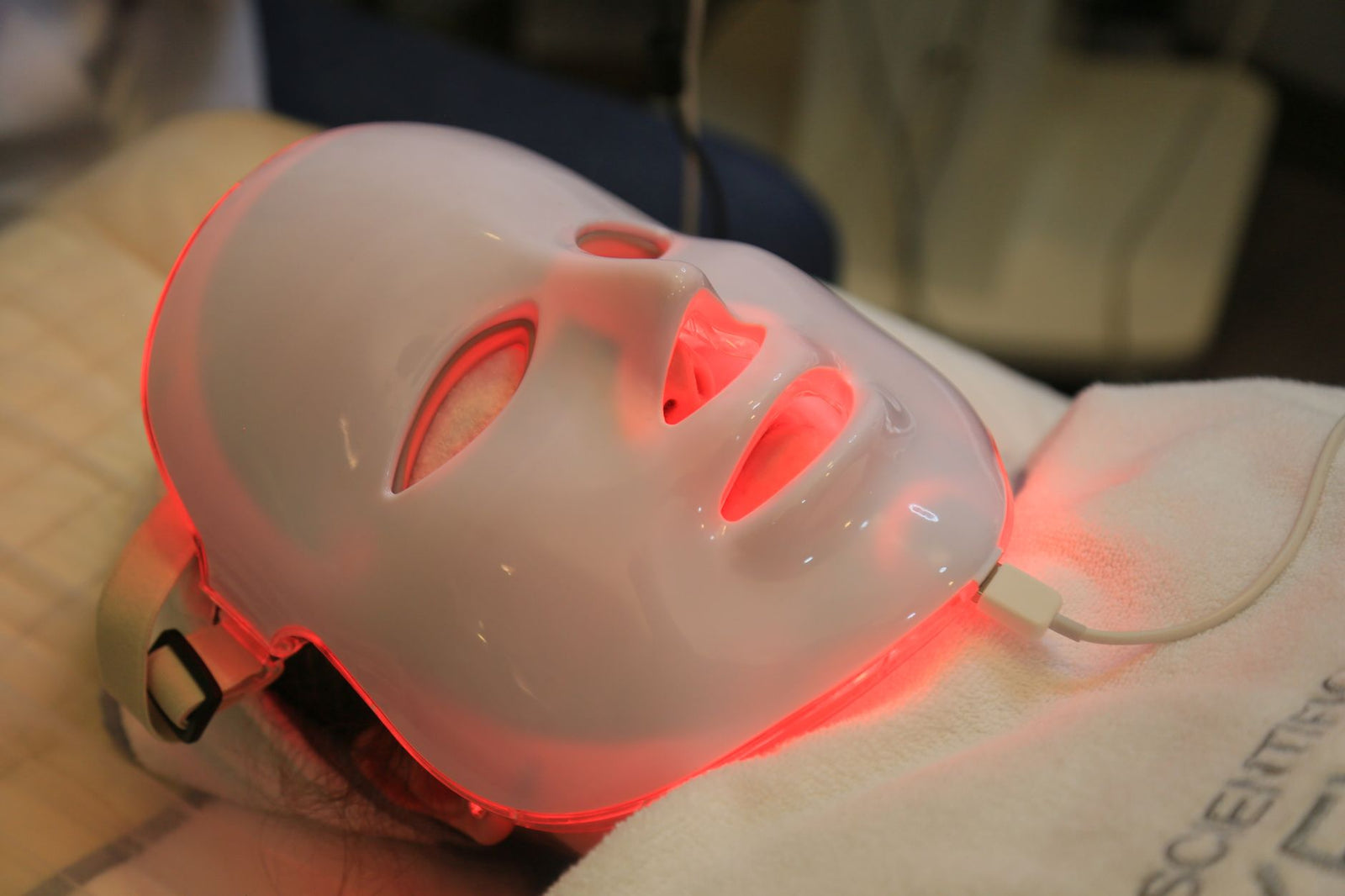
NIR exposure activates mitochondrial cytochrome c oxidase, a complex of the electron transport chain, producing changes in cellular ATP production, reactive oxygen species signalling, and downstream inflammatory and tissue-repair pathways (Patrick & Johnson, 2021) [4]. The mechanism is photochemical rather than thermal and operates independently of the heat-stress response. The bulk of the photobiomodulation clinical evidence base, however, comes from red-light therapy devices (LED panels) rather than from sauna cabins; cabin-specific trial data remain sparse.
The evidence base for each format
The two formats are not symmetrical in their clinical evidence. FIR has the longer track record in cabin-specific clinical trials; NIR has the longer track record in narrow-band photobiomodulation devices, with translation to whole-cabin exposure still being established.
Far-infrared specific clinical data
The Beever 2009 review (Beever, 2009) [2] summarises small trials of far-infrared sauna treatment for cardiovascular risk factors, with consistent effect directions for blood pressure reduction and endothelial function improvement. Hussain & Cohen 2018 (Hussain & Cohen, 2018) [1] covers the wider sauna evidence base, including FIR-specific trials in rheumatoid arthritis, ankylosing spondylitis, fibromyalgia and chronic fatigue conditions, with modest effect sizes but consistent direction.
Near-infrared cabin-specific data
NIR cabin-specific clinical trials are limited. The mechanistic basis for photobiomodulation is well established in red-light therapy LED-panel research, and Patrick & Johnson 2021 reviews the longevity-pathway and HSP-related discussion (Patrick & Johnson, 2021) [4]but the translation from narrow-band LED dose to broad-band cabin halogen exposure is not directly trialled in the cabin format. A buyer paying the full-spectrum premium for NIR effects should treat the cabin-specific evidence as preliminary rather than established.
| Band | Range | Emitter | Penetration | Mechanism | Evidence grade |
|---|---|---|---|---|---|
| NIR | 0.76-1.4 µm | Halogen lamp | 3-5 mm | Photobiomodulation | Limited (cabin); Moderate (LED panel) |
| MIR | 1.4-3 µm | Ceramic rod / halogen tail | 1-2 mm | Surface thermal | Insufficient (band-specific) |
| FIR | 3-1000 µm | Carbon panel / ceramic | <1 mm | Heat-stress response | Moderate |
UK price differential and what it buys
The UK retail market shows a £700-£2,000 premium for full-spectrum cabins over matched FIR-only models of the same capacity, wood specification and brand. The premium reflects the additional halogen module, the dual-emitter controller, and the brand positioning of US-origin full-spectrum lines (Sunlighten, Clearlight, Higherdose) which dominate the upper end of the UK market. A matched-pair comparison from current UK retail data shows the differential is consistent across brand tiers:
| Format and capacity | FIR-only price band | Full-spectrum price band | Typical premium |
|---|---|---|---|
| 1-person | £1,500-£2,800 | £2,400-£4,200 | £800-£1,400 |
| 2-person | £2,200-£4,500 | £3,200-£6,500 | £900-£2,000 |
| 3-person | £3,500-£5,500 | £4,500-£7,500 | £900-£2,000 |
| 4-person | £4,500-£6,500 | £5,500-£8,000+ | £900-£1,500 |
A portion of the premium represents the marginal hardware cost of the halogen module and the controller. The remainder represents the brand positioning of full-spectrum as a premium product line. Specification line-items (wood durability class, EMF disclosure, warranty terms) should be compared independently of the spectrum label.
Decision matrix, which format suits which buyer
The choice between formats is best framed against the underlying mechanism the buyer is targeting, not the marketing label on the box.
- Buyer prioritising recovery and cardiovascular outcomes. FIR is sufficient. The cardiovascular and pain literature is FIR-based; the heat-stress response that drives these outcomes is delivered fully by carbon-panel cabins.
- Buyer seeking red-light or photobiomodulation effects. Full-spectrum, or a FIR cabin with a supplementary NIR LED panel. The NIR band is required for the mechanism.
- Buyer on a £2,000-£3,500 budget. A high-quality FIR cabin with strong build, low EMF and a 5-year heater warranty typically outperforms a budget full-spectrum unit at the same price.
- Buyer planning daily use across multiple household members. Capacity, warm-up time and electrical-supply suitability outweigh spectrum format in this scenario; the same heat-stress response is delivered by either format at appropriate session length.
UK availability by format and brand maps as follows. Vidalux, Telos and SuperSauna sell predominantly FIR cabins at the £1,500-£4,500 price band. Sunlighten, Higherdose and Clearlight sell predominantly full-spectrum cabins at the £3,500-£8,000 price band. Background on overall cabin selection and the UK install context sits in the UK buyers' guideand detail on the underlying spectrum physics appears in the article on how infrared saunas work.
Frequently asked questions
What is full-spectrum infrared?
Full-spectrum infrared describes a sauna cabin that emits across the near, mid and far-infrared bands (0.76-1000 µm). Near-infrared is generated by halogen lamps; far-infrared by carbon panels. Full-spectrum models combine the heat-stress response of far-infrared with the photobiomodulation mechanism associated with near-infrared light (S012). UK full-spectrum cabins typically cost £700-£2,000 more than equivalent far-infrared-only units of the same capacity and wood specification.
Is full-spectrum better than far-infrared?
Full-spectrum is not categorically better than far-infrared. The sauna literature on cardiovascular outcomes (S001, S002) refers chiefly to far-infrared cabins, which deliver the heat-stress response at lower cost. Full-spectrum adds near-infrared photobiomodulation, a separate mechanism with independent evidence (S012) but limited cabin-specific trial data. The format choice depends on whether the buyer's stated benefit derives from raised core temperature (either suffices) or from photobiomodulation (full-spectrum required).
What does near-infrared do that far-infrared does not?
Near-infrared (0.76-1.4 µm) penetrates skin 3-5 mm and activates mitochondrial cytochrome c oxidase, a mechanism termed photobiomodulation (S012). Far-infrared (3-1000 µm) is absorbed at the skin surface and acts via thermal conduction. Photobiomodulation is associated with reported effects on cellular ATP, inflammation and tissue healing in red-light therapy literature, separate from heat-stress effects. Far-infrared cabins do not deliver photobiomodulation because their emission lies beyond the photoactive range.
Why are full-spectrum saunas more expensive?
Full-spectrum saunas cost more because they incorporate halogen near-infrared emitter modules in addition to the carbon far-infrared panels of a standard cabin. The halogen module, dual-spectrum controller and the additional engineering required to manage two emitter types account for a typical UK retail premium of £700-£2,000. Build cost is not the only driver: full-spectrum is also positioned as a premium product line by most US-origin brands sold into the UK.
Do full-spectrum cabins emit visible light?
Full-spectrum cabins emit a small visible-red component from the halogen near-infrared lamps; the visible glow is incidental to the NIR output and is not the therapeutic component. Some cabins also fit chromotherapy LEDs that are decorative rather than therapeutic. Visible light (0.4-0.76 µm) is outside the infrared spectrum, and visible LEDs do not contribute to the heat-stress response or to photobiomodulation in the established sense.
Can I add near-infrared to a far-infrared sauna?
Near-infrared can be added to an existing far-infrared cabin via a standalone NIR LED panel mounted to the wall or door. Aftermarket panels supply 660 nm visible-red and 850 nm near-infrared at a fraction of a full-spectrum upgrade cost. The panel delivers photobiomodulation only; it does not increase cabin heat load. UK availability is widespread, with units typically priced at £200-£700. Manufacturer warranties may exclude installations not approved for the cabin model.
Which infrared band is best for muscle recovery?
Muscle recovery in the sauna literature is associated chiefly with the heat-stress response and the cardiovascular adaptations that follow it (S001). Both far-infrared and full-spectrum cabins deliver this response. Near-infrared photobiomodulation has separate evidence in red-light therapy for tissue repair (S012), but cabin-specific trials are limited. Either format is therefore defensible for recovery; the format choice should be governed by budget, install constraints and tolerance of heat.
Does the marketing claim of "cellular healing" hold up?
The phrase "cellular healing" is not a defined clinical outcome and is not used in the peer-reviewed sauna literature. The closest documented mechanism is photobiomodulation, which describes near-infrared activation of mitochondrial cytochrome c oxidase (S012). This mechanism is band-specific to near-infrared and is therefore not delivered by far-infrared-only cabins. Buyers reading "cellular healing" in marketing copy are advised to check which spectrum the cabin actually emits before purchase.
References
- Hussain J, Cohen M. Clinical Effects of Regular Dry Sauna Bathing: A Systematic Review. Evidence-Based Complementary and Alternative Medicine, 2018. DOI: 10.1155/2018/1857413.
- Beever R. Far-infrared saunas for treatment of cardiovascular risk factors. Canadian Family Physician, 2009; 55(7): 691-696.
- International Commission on Non-Ionizing Radiation Protection (ICNIRP). Guidelines on Limits of Exposure to Incoherent Visible and Infrared Radiation. Health Physics, 2013; 105(1): 74-96.
- Patrick RP, Johnson TL. Sauna use as a lifestyle practice to extend healthspan. Experimental Gerontology, 2021; 154: 111509.