Barrel vs Cube vs Pod: Outdoor Sauna Shapes Compared
By Telos Wellness Editorial Team. Last reviewed 17 August 2026.
A barrel sauna, a cube sauna and a pod sauna are three outdoor-sauna form factors that all reach the same operating temperature (80–95°C traditional, 50–60°C infrared) but differ in heat circulation, footprint and structural longevity in UK climate. The barrel circulates heat by convection along its curved roof; the cube heats more evenly and seats more people per square metre; the pod is the most compact. This guide compares all four common shapes — barrel, cube, pod, hut.
The four outdoor sauna form factors at a glance
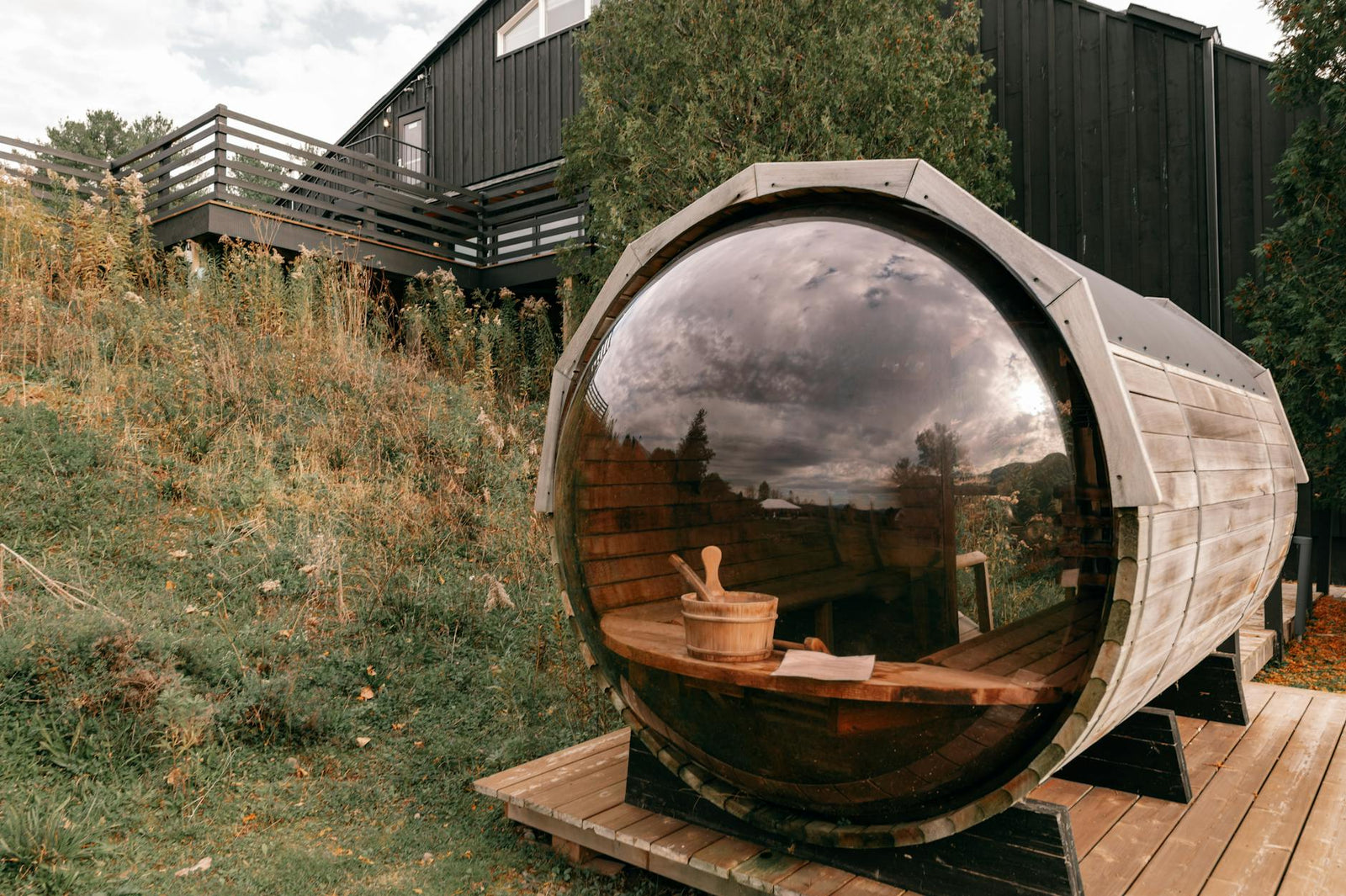
Outdoor saunas in UK gardens fall into four shell geometries. A barrel is a horizontal cylinder formed of staves with end caps. A cube is a rectangular timber-framed cabin with flat walls and roof. A pod is a small rounded shell, typically composite or curved-frame with thermo-aspen cladding. A hut is the traditional pitched-roof timber cabin in the Finnish form. All four reach the same Finnish or infrared operating temperatures — the choice of heater type is independent of shell shape, as set out in the wood-fired versus electric heater comparison. The decision between shapes is governed by four factors: heat circulation during a session; footprint and bench capacity; structural longevity under UK rainfall and freeze-thaw; and aesthetic fit.
Barrel sauna — convection geometry
A barrel sauna heats faster than a cube of similar volume because the curved roof channels convection currents back over the bathers, leaving fewer cold pockets. Choice of barrel suits two-person and small-group sessions where speed of warm-up and rustic aesthetic are the priority.
Heat circulation in a barrel
The curved roof of a barrel sauna directs rising hot air along its arc, returning it to the bench level rather than allowing it to stratify against a flat ceiling. The result is faster warm-up to operating temperature and less of a vertical temperature gradient between floor and top bench. The barrel reaches 80–90°C at the top bench in approximately 30–40 minutes from cold with a 6 kW electric heater — roughly 15–25% faster than a cube of equivalent internal volume.
Footprint, capacity and bench layout
Footprint sits at 2.5–5.5 m² external floor area for 2-, 4- and 6-person configurations common in UK supply. Bench layout is parallel benches running along the length of the barrel on either side. Head clearance is constrained at the curve apex — bathers seated tall may touch the curved roof in the smallest 2-person barrel. The 4-person barrel resolves this by widening the diameter.
Longevity of barrel staves in UK climate
A well-maintained barrel sauna in UK climate lasts 15–20 years on Nordic spruce staves [5] and 20–25 years on thermo-aspen [1, 5]. Service life is governed by the wood's BS EN 350-2 durability class, the roof system, freeze-thaw exposure, and whether the cabin is on a level base with drainage. Ends are the failure point: water tracks through the end-cap joints, so drainage and end-cap detailing matter more on a barrel than on a cube. Telos install logs report drainage at barrel ends as the most common shape-specific snag [2].
Cube sauna — even heating and modular fit
A cube sauna heats more evenly than a barrel and seats more people per square metre of footprint. The flat roof permits tiered benches with higher head clearance; the modular envelope sits well against fences and outbuildings.
Heat circulation in a cube
Convection inside a cube produces classical stratification — the top bench notably hotter than the bottom. The flat ceiling permits a stable hot layer to form at the upper third of the cabin volume, which is the bathing band. Warm-up time is longer than a barrel of similar volume: 35–50 minutes from cold with a 6 kW heater. Energy use per session is correspondingly higher.
Footprint, capacity and bench layout
Footprint runs 2.0–6.0 m² for 2- to 6-person configurations. The rectangular plan provides higher seating capacity per m² than a barrel. Bench layout is typically tiered — lower step, mid bench, top bench — with head clearance at the top bench typically 1.0–1.1 m below the ceiling, matching Suomen Saunaseura convention as set out in the Finnish home sauna article.
Longevity and panel construction
Cube saunas are built from panel construction — timber-frame studs with mineral wool insulation between, internal thermo-aspen or aspen cladding, and external thermo-pine or thermo-aspen siding. Roof systems are typically EPDM or felt shingle. A well-built cube lasts 15–25 years in UK climate [5]. The flat roof sheds water cleanly when fitted with adequate fall; standing water at flat-roof corners is the typical attrition point if drainage is inadequate.
Pod sauna — compact and contemporary
A sauna pod is a compact outdoor sauna with a rounded shell, typically 1.5–3.0 m² external footprint and seating one to three adults. Pods are usually clad in vertical thermo-aspen or thermo-pine over a curved composite frame, often with a panoramic curved-glass front. Heat-up is fast given the small internal volume. Pods suit small UK gardens and contemporary architectural settings where a hut or barrel would dominate.
Heat circulation in a pod
The small internal volume of a pod reaches temperature quickly — 25–35 minutes from cold with a 4.5 kW heater. Convection paths are short, so even fill is achieved without significant stratification. The curved-glass front contributes radiant loss at the bathers' position but provides the outward view that is the pod's primary aesthetic appeal.
Footprint, capacity and bench layout
Pod footprint sits at 1.5–3.0 m² — the only form factor that fits gardens under 25 m² total ground area. Capacity is 1–3 adults with limited bench depth. The bench is usually a single tier across the rear wall, or an L-shaped two-section bench in larger pods.
Longevity of curved-glass and composite shells
Pod service life sits at 15–20 years in UK climate. The composite shell or thermowood cladding is generally durable; the curved-glass front and its weatherproof seals are the typical attrition point. UV degradation of seals is the main wear mechanism. Telos install logs report pod door alignment as a recurring snag [2]. Met Office UK climate averages indicate routine freeze-thaw cycles across most of the UK [6]; seal life sits at 8–12 years before refresh.
Hut sauna — the traditional Finnish form
A hut sauna is the traditional pitched-roof timber cabin in the Finnish form, the longest-lived shape in UK conditions when properly maintained.
Heat circulation in a hut
A timber-frame hut produces tiered convection — bench levels carry distinct temperature bands. The löyly response is most pronounced because hut volume is typically larger and the heater stone capacity is correspondingly higher. Warm-up time is the longest of the four shapes: 45–60 minutes from cold with a 6 kW electric, longer for wood-fired.
Footprint, capacity and bench layout
Hut footprint sits at 3.0–9.0 m² for the cabin alone, with combined porch or changing room adding to the total. Capacity ranges 2–8 bathers. The classical three-tier bench layout meets Suomen Saunaseura specifications [4].
Longevity of timber-frame huts
A timber-frame hut lasts 20–40 years in UK climate when maintained — the longest service life of any shape [5]. Service life depends on the roof system being maintained on schedule, the cladding being treated where appropriate, and the cabin sitting on a level base with drainage. Huts are the only form factor in this list that can be re-clad in the field, extending structural life beyond the original cladding.
Side-by-side comparison table
| Attribute | Barrel | Cube | Pod | Hut |
|---|---|---|---|---|
| Footprint (m²) | 2.5–5.5 | 2.0–6.0 | 1.5–3.0 | 3.0–9.0 |
| Capacity (adults) | 2–6 | 2–6 | 1–3 | 2–8 |
| Price band (£, 2026) | 3,500–8,500 | 4,500–12,000 | 4,000–11,000 | 6,000–20,000+ |
| Heat-up (6 kW, min) | 30–40 | 35–50 | 25–35 | 45–60 |
| UK service life (years) | 15–25 | 15–25 | 15–20 | 20–40 |
| Assembly (h, two installers) | 6–12 | 8–16 | 4–8 | 16–40 |
| Typical wood | Nordic spruce / thermo-aspen | Thermo-aspen / spruce panel | Thermo-aspen / composite | Spruce timber-frame / aspen |
| Roof system | Felt shingle / bitumen | EPDM / sedum / felt shingle | Composite shell | Felt shingle / EPDM |
| Aesthetic | Rustic | Contemporary | Minimalist | Traditional |
| Typical attrition point | End-cap drainage | Flat-roof drainage | Curved-glass seals | Roof maintenance |
Price, planning permission and aesthetic fit
2026 UK price bands per shape are summarised above. All four shapes can sit within Class E Permitted Development provided they meet the height, boundary and garden-coverage rules — height ≤2.5 m within 2 m of any boundary, ≤50% garden coverage, not in front of the principal elevation, and not on listed or Article 4 / conservation-area property [3]. Most barrel, cube and pod saunas land within those limits; some hut configurations exceed 2.5 m and require careful siting away from boundaries. Full rules are set out in the garden sauna planning permission guide.
Aesthetic-fit decision aid — a stepped list:
- If the garden is contemporary or minimalist in style — choose pod or cube.
- If the garden is rustic, cottage or rural in style — choose barrel or hut.
- If the property sits in a conservation area or near a listed building — choose hut (traditional form) or barrel (low pitch) and confirm with planning officer.
- If the garden is under 25 m² total area — choose pod (only viable option that respects coverage rules).
- If the household uses the cabin for groups of 4 or more — choose cube or hut.
- If the cabin must be wheeled in through a side passage — choose pod or small barrel (modular barrel staves disassemble).
Which shape suits which garden
Three garden archetypes summarise the UK market:
- Small urban (<25 m²). Pod or small 2-person barrel. Both stay below the 2.5 m height limit within 2 m of a boundary under Class E Permitted Development. A cube of equivalent capacity has a larger footprint; a hut typically conflicts with the 50% garden-coverage rule [3].
- Medium suburban (25–80 m²). Cube or 4-person barrel suits this range. Either fits comfortably within Class E rules with margin for landscaping. Pod remains viable if compactness is preferred over capacity.
- Large rural (>80 m²). Hut comes into range, with timber-frame longevity (20–40 years) [5] favouring the long-term value case. Combined porch or changing-room layouts add usability.
Frequently asked questions
Barrel sauna or cube sauna — which is better for two people?
For a two-person session, both work. A 4-foot barrel reaches operating temperature 15–25% faster than a cube of similar volume because of the convection loop along its curved roof. A cube of the same capacity offers higher head clearance and a flatter bench. Choice depends on whether speed of warm-up and rustic aesthetic (barrel) or head room and modular fit against a wall (cube) is the priority for the UK garden in question.
What is a sauna pod?
A sauna pod is a compact outdoor sauna with a rounded shell, typically 1.5–3.0 m² external footprint and 1–3 person capacity. The shell is usually a composite or curved-frame structure with thermo-aspen or thermo-pine cladding and, often, a curved-glass front. Pods reach operating temperature quickly because the internal volume is small. Pods suit small UK urban gardens where a barrel or cube would dominate the available ground area.
How long does a barrel sauna last in the UK climate?
A Nordic spruce barrel sauna lasts 15–20 years in UK climate when maintained — staves resealed every 2–3 years, roof felt or shingle replaced at the recommended interval, end caps inspected annually for moisture ingress. A thermo-aspen barrel lasts 20–25 years. Service life is reduced if the cabin sits on poor drainage, is positioned under deciduous trees, or is placed on the windward side without shelter.
Can a sauna hut fit in a small UK garden?
A small Finnish hut starts at around 3.0 m² external footprint and rises sharply with bench-tier configurations. In a UK garden under 25 m² total, a hut typically conflicts with the 50% garden-coverage rule under Class E Permitted Development. Pods and small barrels are the practical choice in that footprint range.
Does the shape change the health benefit?
The physiological effect of sauna bathing depends on the heat dose — temperature, humidity and time — not on the shell shape. All four form factors reach the operating temperatures used in the cardiovascular and HSP studies. Shape governs heat-up speed, capacity, footprint and aesthetic, not the underlying response.
Which shape is easiest to assemble?
A sauna pod is the easiest, with assembly typically 4–8 hours for two installers. A barrel sauna is next at 6–12 hours. A cube takes 8–16 hours depending on panel system. A timber-frame hut is the most involved, often 16–40 hours over multiple days. Telos install logs (S019) report the most snags on barrel end-cap fitting and pod door alignment.
Which form factor is most weather-resistant?
A cube sauna with EPDM or sedum roofing and a thermo-aspen exterior is the most weather-resistant in UK climate over the long term, given the larger flat roof can shed water efficiently and the panel insulation provides a continuous thermal envelope. Barrels are also weather-resistant but require attention to drainage at the ends; pods are constrained by seal life on curved glass; huts vary by build quality.
Do all four shapes require planning permission?
Under Class E Permitted Development, none requires planning permission provided height is ≤2.5 m within 2 m of any boundary (or ≤4 m gable / 3 m flat-roof elsewhere), the outbuilding occupies ≤50% of the garden, and the property is not listed nor in an Article 4 / conservation area. Most barrel, cube and pod saunas land within those limits; some hut configurations exceed 2.5 m and require careful siting. Full rules in the linked planning-permission guide.
References
- Sauna Society of Finland. Technical bulletin on wood material selection (Aapa Sauna 2018, English translation). (S018)
- Telos Wellness internal install logs, 2024–2026. (S019)
- UK Planning Portal. Outbuildings — height and boundary rules (Class E Permitted Development). (S020)
- Suomen Saunaseura (Finnish Sauna Society). Sauna construction and bench-tier specifications. (S023)
- Forestry Commission UK / British Standards. BS EN 350-2 timber durability classes. (S022)
- Met Office. UK Climate Averages 1991–2020. (S021)
���������������������������������������������������������������������������������������������������������������������������������������������������������������������������������������������������������������������������������������������