Wood-Fired vs Electric Outdoor Saunas in the UK
By Telos Wellness Editorial Team. Last reviewed 19 August 2026.
A wood-fired sauna heats by combustion of kiln-dried hardwood inside a steel stove with a flue, reaching 80-95°C in 45-75 minutes; an electric outdoor sauna heats by resistive elements over heater stones, reaching the same temperature in 35-60 minutes from a 6-9 kW heater on a dedicated 32 A circuit. The decision between them in the UK is governed by Smoke Control Areas under the Clean Air Act 1993, wood supply, and electrical access. This guide sets out both.
What separates the two heater types
The decision rests on three factors: regulatory exposure (Smoke Control Area status, Building Regulations Approved Documents J and P), supply logistics (electrical circuit capacity, kiln-dried wood storage), and ritual preference. The physiological effect is similar across both types within the same envelope. What differs is what surrounds the heater: the flue, the circuit, the fuel handling, and the user experience. Households inside a designated Smoke Control Area (most urban UK authorities) face a narrower choice and typically install electric. Households outside SCAs, off-grid, or with strong preference for the ritual of combustion typically install wood-fired.
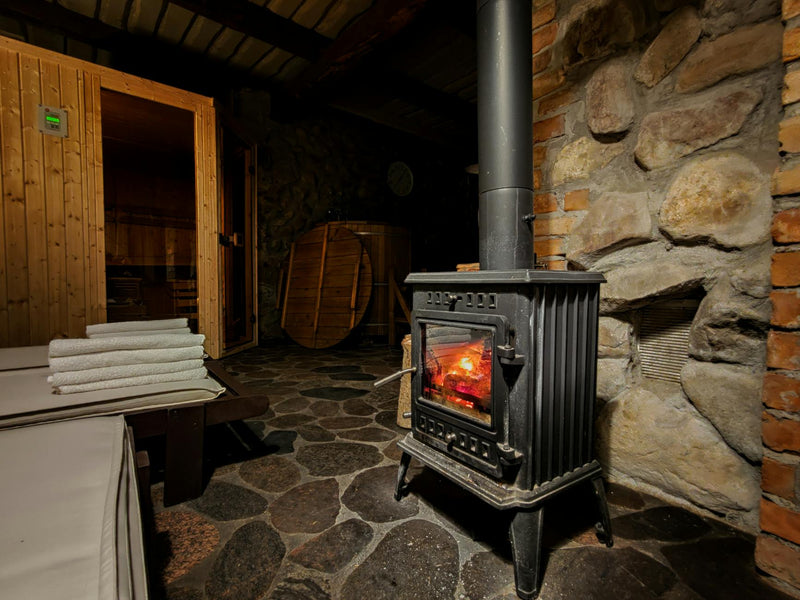
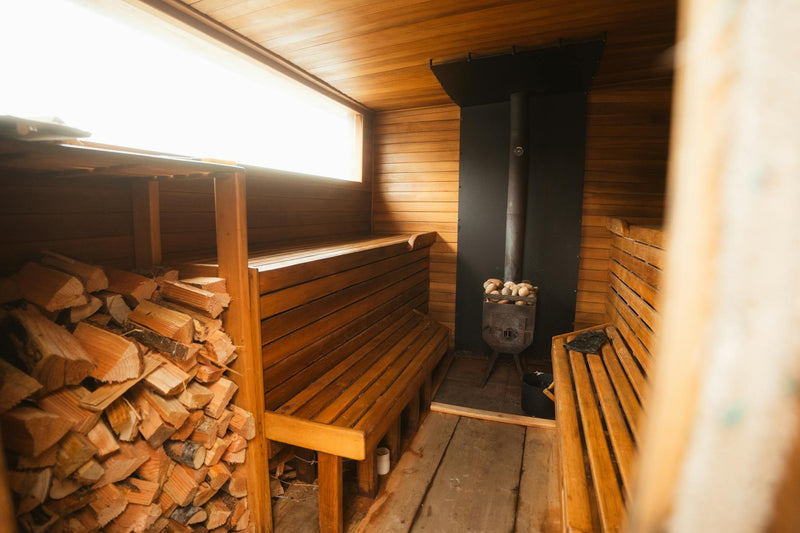
Wood-fired outdoor sauna, characteristics
A wood-fired sauna gives stronger löyly response, deeper ritual and independence from electrical supply but requires a HETAS-compliant flue, kiln-dried hardwood at ~6-12 kg per session, and (if the garden falls inside a UK Smoke Control Area) a Defra-exempt stove [5].
Heat-up time, peak temperature and löyly behaviour
Heat-up time runs 45-75 minutes from cold start to 90°C in a typical 4-6 m³ cabin. The temperature ramps less linearly than electric, an initial steep rise as the firebox reaches operating temperature, then a plateau as the cabin equilibrates. Peak temperatures of 90-100°C are achievable at the top bench. The radiant heat off the stove body is greater than from an electric heater of equivalent thermal output, which produces a stronger löyly response when water is thrown onto the heater stones.
Chimney and flue installation
A wood-fired sauna requires a twin-wall insulated flue (typically 125 mm internal diameter), HETAS-installed to Building Regulations Approved Document J, with appropriate fire-stop plates through the cabin roof and a termination height meeting both the manufacturer's instructions and the building's surroundings [5]. The flue rises through the cabin roof with a fire-stop plate and is supported externally. No outdoor wood-fired sauna can be operated safely or legally without one. Installation cost runs £400-£900 for the flue kit and labour on a typical garden cabin.
Wood supply, what to burn and how much per session
Authorised fuel is kiln-dried hardwood at ≤20% moisture; inside a Smoke Control Area the wood must be ready-to-burn certified under the Air Quality (Domestic Solid Fuels Standards) (England) Regulations 2020 [4]. A typical 45-minute session in a 4-6 m³ cabin consumes 6-12 kg, roughly two to four armfuls. One tonne of kiln-dried hardwood (£400-£550 delivered in 2026 UK pricing) supplies 80-160 sessions.
| Use frequency | Sessions / year | Wood required / year | Storage volume | Indicative cost |
|---|---|---|---|---|
| 1 session / week | 52 | 0.3-0.6 t | 0.6-1.2 m³ | £120-£330 |
| 2 sessions / week | 104 | 0.7-1.4 t | 1.5-3.0 m³ | £280-£770 |
| 3 sessions / week | 156 | 1.0-2.0 t | 2.0-4.0 m³ | £400-£1,100 |
| 4 sessions / week | 208 | 1.3-2.6 t | 2.6-5.2 m³ | £520-£1,430 |
Storage is a dry, covered, ventilated wood store sized for at least one year of use. Stacked log volume sits roughly 2× the loose-tonne volume.
Maintenance and ash management
Ash management is per session: the ash pan is emptied after each session once the contents have cooled. Annual flue sweep is required, certificated by a HETAS-registered chimney sweep, and most buildings insurers require evidence of the certificate. Stove gasket inspection is annual; gasket replacement falls at 3-5 year intervals depending on use intensity. Stones on top of the stove are inspected and rotated annually, replaced every 2-3 years for typical home use.
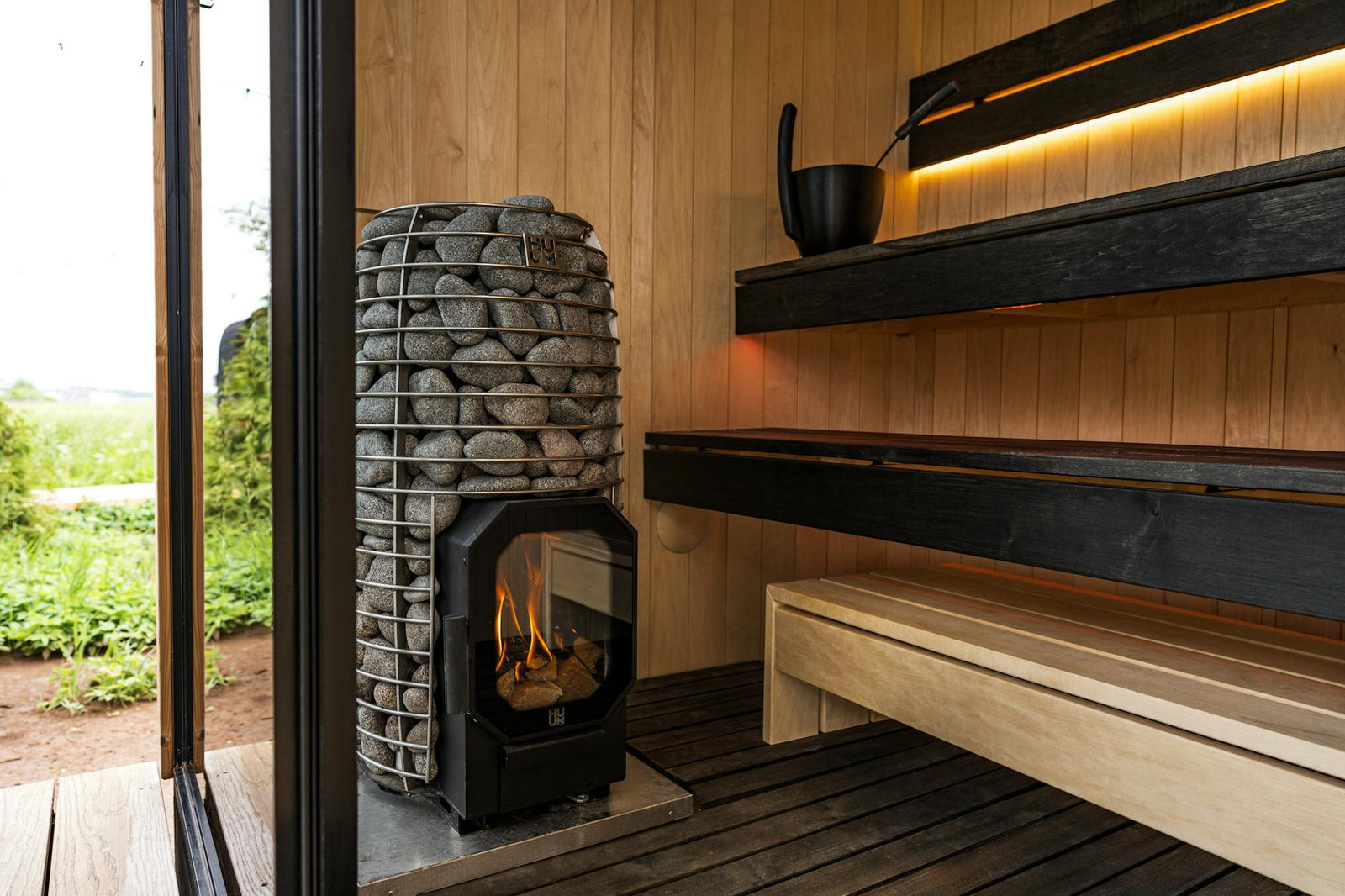
Electric outdoor sauna, characteristics
An electric outdoor sauna heats faster, requires no fuel handling, and is the only choice inside Smoke Control Areas where Defra-exempt wood appliances are not available for the specified cabin volume.
Heat-up time and controller options
An electric heater of 6-9 kW reaches 80-90°C in a typical 4-9 m³ cabin in 35-60 minutes. Controller types are detailed in the sauna heater guide: built-in dial, external wall pad, or wifi-enabled with phone app. Pre-heat from outside the cabin is the typical reason for upgrading from the built-in dial.
Electrical install, circuit, certification and Approved Doc P
A 4-4.5 kW electric heater can run on a 16 A circuit. A 6-9 kW heater requires a dedicated 32 A hardwired circuit. Both must be installed by a Part P registered electrician (NICEIC, NAPIT or ELECSA), with a Part P notification and an Electrical Installation Certificate covering BS 7671:2018+A2:2022 compliance [1, 2]. Long garden cable runs may need a larger conductor than the standard 4 mm² or 6 mm² because of voltage drop. A 30 mA RCD is mandatory.
Stones, kW-per-m³ sizing and IEC 60335-2-53 safety
The traditional Finnish rule of thumb is approximately 1 kW per m³ of internal cabin volume for an electric heater. A 4 m³ cabin requires 4.5 kW; 6 m³ requires 6 kW; 8 m³ requires 8 kW. Stone capacity sits at 20-30 kg on a compact 4.5 kW heater, 30-40 kg on a 6 kW heater, 60-100 kg on a 9 kW floor-standing heater. IEC 60335-2-53 governs over-temperature cut-out at 140°C cabin air, minimum clearances from combustibles, and contact-surface temperature on the heater body [3].
Running cost in £ per session
A 6 kW heater drawing for approximately 35-45 minutes of warm-up plus idle through a 45-minute session consumes 4.5-5.5 kWh. At the 2026 UK Energy Price Cap rate of 27.03 p/kWh, that produces a per-session cost of £1.22-£1.49; lower with off-peak tariffs. The annual cost for two sessions per week sits around £100-£140.
Heater-type comparison matrix
| Attribute | Wood-fired | Electric |
|---|---|---|
| Heat-up time (4-6 m³ cabin) | 45-75 min | 35-60 min |
| Peak operating temperature | 90-100°C | 80-95°C |
| Thermal output | 15-24 kW | 6-9 kW (electrical) |
| Cost per session (£, 2026) | 0.50-1.20 | 0.55-1.49 |
| Chimney / flue | Required (HETAS, twin-wall, Approved Doc J) | None |
| Circuit | 13 A for controls/light | 16 A (≤4.5 kW) or 32 A (≥6 kW) |
| Smoke Control Area compatibility | Defra-exempt stove only | Unrestricted |
| Wood supply | 6-12 kg / session, ready-to-burn | None |
| Maintenance | Ash each session; annual flue sweep; gasket 3-5 yr | Stone replacement 12-24 mo; element check |
| Ritual / sensory | Scent, sound, slower ramp | Consistent, timer-controllable, wifi-controllable |
| Off-grid suitability | Yes | No |
UK Smoke Control Areas and the Clean Air Act 1993
Wood-fired saunas are legal in UK gardens but constrained by the Clean Air Act 1993 inside designated Smoke Control Areas. Inside an SCA (which covers most urban authorities) only Defra-exempt appliances burning authorised fuels (kiln-dried wood ≤20% moisture, ready-to-burn certified) may be used [4]. Outside SCAs the appliance is unrestricted but Building Regulations Approved Document J still applies to the flue and combustion appliance install [5]. The UK Government Clean Air Act 1993, the Air Quality (Domestic Solid Fuels Standards) (England) Regulations 2020 and the Defra ready-to-burn framework are not Telos seed-site sources but are the controlling regulations for UK users; this section cites them as the authoritative reference.
A Smoke Control Area is checked at the local authority's website or via the Defra SCA finder. Penalty exposure for non-compliance reaches £300 per offence; the appliance must be on the Defra exempt list at the point of install. Inside an SCA, the wood supply must carry the ready-to-burn logo, the moisture content must be ≤20%, and the appliance certificate must be retained.
Planning permission, building regulations and insurance
Planning permission requirements are not driven by heater type. The Class E Permitted Development rules apply equally to wood-fired and electric cabins, height ≤2.5 m within 2 m of any boundary, ≤50% of garden coverage, not in front of the principal elevation. Full rules are in the garden sauna planning permission guide.
Building Regulations differ by heater type. A wood-fired sauna invokes Approved Document J for the combustion appliance and flue; HETAS-registered install is the conventional route to certification [5]. An electric sauna invokes Approved Document P for the circuit; Part P notification and an Electrical Installation Certificate under BS 7671 cover the install [1, 2].
Buildings insurance treats a wood-fired outdoor sauna as a solid-fuel-burning outbuilding, which is a notifiable risk. Most UK insurers cover it provided the install was carried out by a HETAS-registered installer who issued a certificate, the flue is swept annually by a HETAS-registered sweep, and the cabin is sited at a compliant distance from the main dwelling. Failure to disclose can void cover.
Decision matrix, which heater type by use case
| Use case | Recommended heater |
|---|---|
| Inside SCA, no Defra-exempt stove available for cabin size | Electric |
| Inside SCA, Defra-exempt stove available | Either |
| Outside SCA, mains electricity within 15 m of cabin | Either |
| Off-grid garden, no mains supply within reasonable run | Wood-fired |
| Rented property, no provision for fixed flue install | Electric |
| Frequent solo use, weekday evenings, timer needed | Electric |
| Strong ritual preference (scent, sound, combustion) | Wood-fired |
| Conservation area, restrictions on visible flue termination | Electric |
Hybrid and dual-fuel considerations
Some Finnish manufacturers offer cabins designed for both a wood-fired stove and a small electric back-up heater, a niche category. The use case is a primary wood-fired experience with electric preheating for short-notice use, or for redundancy in case of fuel-supply interruption. Hybrid configurations require both Approved Document J (for the flue) and Approved Document P (for the circuit) certifications and add to install complexity. Future-proofing for an off-grid or EV-only setup is the typical buyer rationale.
Frequently asked questions
Wood-fired vs electric, which heats faster?
An electric outdoor sauna heats faster on average: 35-60 minutes from cold to 80-90°C in a typical 4-6 m³ cabin, against 45-75 minutes for a wood-fired stove. The gap narrows once the stove body is at temperature. Repeat sessions on the same evening are faster for both. The difference is not large enough to be decisive on its own; SCA rules, electrical access and ritual preference matter more.
Do wood-fired saunas need a chimney?
Yes. A wood-fired sauna requires a twin-wall insulated flue (typically 125 mm internal diameter) installed to UK Building Regulations Approved Document J, with appropriate fire-stop plates through the cabin roof and a termination height meeting both the manufacturer's instructions and the building's surroundings. Installation should be carried out by a HETAS-registered installer who issues a certificate for the buildings insurer.
Are wood-fired saunas legal in UK gardens?
They are legal but constrained inside Smoke Control Areas under the Clean Air Act 1993. Inside an SCA (covering most urban local authorities), only Defra-exempt appliances may be used, burning authorised "ready to burn" fuels, kiln-dried wood at ≤20% moisture, manufactured solid fuels certified to the Air Quality (Domestic Solid Fuels Standards) (England) Regulations 2020. Outside an SCA the appliance is unrestricted, but Approved Document J still applies.
What circuit does an electric outdoor sauna need?
A 4-4.5 kW electric heater can run on a 16 A circuit. A 6-9 kW heater requires a dedicated 32 A hardwired circuit. Both must be installed by a Part P registered electrician (NICEIC, NAPIT or ELECSA), with a Part P notification and an Electrical Installation Certificate covering BS 7671:2018+A2:2022 compliance. Long garden cable runs may need a larger conductor than the standard 4 mm² or 6 mm² because of voltage drop.
How much wood does a wood-fired sauna burn per session?
A typical 45-minute session in a 4-6 m³ cabin consumes 6-12 kg of kiln-dried hardwood, roughly two to four armfuls. One tonne of kiln-dried hardwood (£400-£550 delivered in 2026 UK pricing) supplies 80-160 sessions. Storage for a year of twice-weekly use is approximately 0.7-1.4 tonnes, around 1.5-3 m³ of stacked log volume in a covered, ventilated store.
What does each cost to run per session?
A wood-fired session costs £0.50-£1.20 in fuel (kiln-dried hardwood at £400-£550 per tonne). An electric session at a 6 kW heater drawing for about 35-45 minutes of warm-up and idle costs £0.55-£1.05 at the 2026 UK Energy Price Cap rate of 27.03 p/kWh. Annual costs for two sessions per week sit around £100-£140 for either type, before any fixed standing charges.
Is planning permission required for a wood-fired sauna?
Planning permission requirements are not driven by heater type. The Class E Permitted Development rules apply equally to wood-fired and electric cabins, height ≤2.5 m within 2 m of any boundary, ≤50% of garden coverage, not in front of the principal elevation. The difference is in Building Regulations: a wood-fired sauna invokes Approved Document J for the combustion appliance and flue; an electric sauna invokes Approved Document P for the circuit.
Will the buildings insurer cover a wood-fired sauna?
Buildings insurance treats a wood-fired outdoor sauna as a solid-fuel-burning outbuilding, which is a notifiable risk. Most UK insurers cover it provided the install was carried out by a HETAS-registered installer who issued a certificate, the flue is swept annually by a HETAS-registered sweep, and the cabin is sited at a compliant distance from the main dwelling. Failure to disclose can void cover.
References
- UK Building Regulations. Approved Document P (Electrical Safety, Dwellings, 2013 ed.). (S016)
- IET. BS 7671:2018+A2:2022 Wiring Regulations. (S017)
- IEC 60335-2-53. Household and similar electrical appliances (Safety) Particular requirements for electric sauna heating appliances. (S024)
- UK Government. Clean Air Act 1993; Air Quality (Domestic Solid Fuels Standards) (England) Regulations 2020; Defra ready-to-burn framework. (Brief flags as non-S source, controlling UK regulation.)
- HETAS. Domestic Combustion Compliance Guide; Approved Document J twin-wall flue installation. (Brief flags as non-S source, controlling UK regulation.)
- Forestry Commission / British Standards. BS EN 350-2 timber durability classes. (S022)