Sauna Heater Guide: Electric, Wood-Fired, Infrared
By Telos Wellness Editorial Team. Last reviewed 24 August 2026.
A sauna heater is the appliance that delivers thermal energy into a sauna cabin, electric wall-mounted, electric floor-standing, wood-fired stove or infrared array. Traditional cabins size at approximately 1 kW per m³ of internal volume; infrared cabins size lower because radiant transfer reaches the body directly. Stone capacity ranges from 20 kg on a 4.5 kW heater to 60 kg on a 9 kW heater. Safety is governed by IEC 60335-2-53.
The four sauna heater categories
Sauna heaters fall into four categories: electric wall-mounted, electric floor-standing, wood-fired stove (kiuas) and infrared emitter array. The first three serve traditional Finnish cabins operating at 80-100°C with heater stones and the löyly response; infrared serves a fundamentally different envelope (45-60°C, no water, radiant delivery). Choice of category follows three questions: cabin volume; site (indoor vs outdoor, Smoke Control Area vs not); and operating envelope (Finnish vs infrared). The Finnish home cabin context is set out in the Finnish sauna at home article; the infrared comparison is in infrared versus traditional.
Electric wall-mounted heaters
Construction and typical kW range
An electric wall-mounted heater is a stainless-steel or coated-steel chassis containing nichrome resistive elements with a stone tray above. Typical UK product power ratings: 3.5, 4.5, 6, 8 and 9 kW. 3.5-4.5 kW models run on 16 A single-phase circuits; 6 kW and above require a 32 A hardwired circuit [2, 3]. Wall mounting requires a stud wall capable of taking the heater weight (typically 15-25 kg dry, more with stones loaded) and minimum clearances from combustibles per IEC 60335-2-53 [1].
Best fit by cabin size and ceiling height
| Heater kW | Cabin volume | Persons | Circuit |
|---|---|---|---|
| 3.5 kW | 2.5-4.0 m³ | 1-2 | 16 A |
| 4.5 kW | 4.0-6.0 m³ | 2-3 | 16 A |
| 6 kW | 6.0-9.0 m³ | 3-4 | 32 A |
| 8 kW | 8.0-12.0 m³ | 4-6 | 32 A |
| 9 kW | 9.0-14.0 m³ | 5-7 | 32 A |
Ceiling height above 2.1 m adds cabin volume disproportionately. A cabin that is 2.0 m × 2.0 m floor with a 2.4 m ceiling sits at 9.6 m³ rather than 8 m³ and may require the next kW class.
Electric floor-standing heaters
Construction and typical kW range
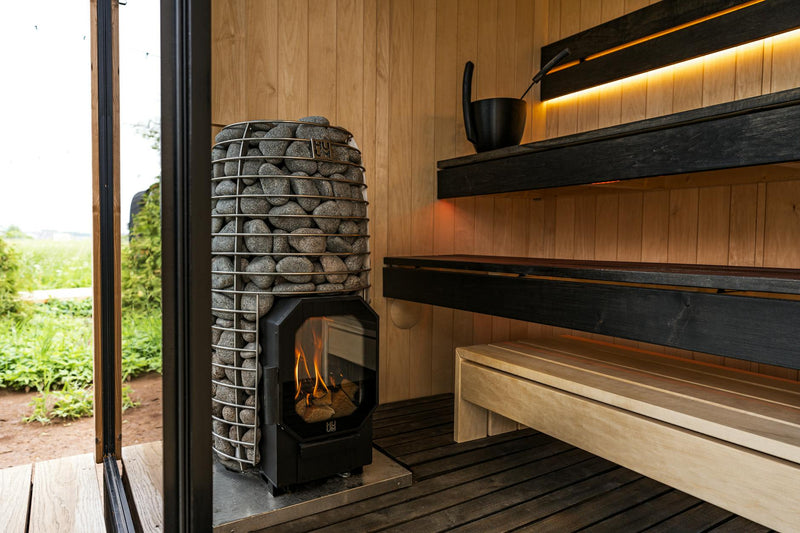
A floor-standing heater is a larger frame with greater stone capacity, suited to higher-volume cabins. Typical UK product power ratings: 9, 10.5, 12 and 15 kW. Higher ratings may require 3-phase supply. Floor-standing heaters carry 60-100 kg of stones, substantially more than wall-mounted equivalents, with corresponding gains in thermal mass and löyly quality.
When floor-standing is the right choice
Floor-standing heaters are the right choice for cabins above approximately 10 m³, for commercial-spec home installations where stone capacity (and therefore löyly behaviour) is prioritised, and where wall-mounting is unsuitable due to wall construction or aesthetic. The freestanding chassis sits on a non-combustible base with minimum clearance to surrounding bench framing per IEC 60335-2-53 [1].
Wood-fired stoves (kiuas)
Construction and combustion characteristics
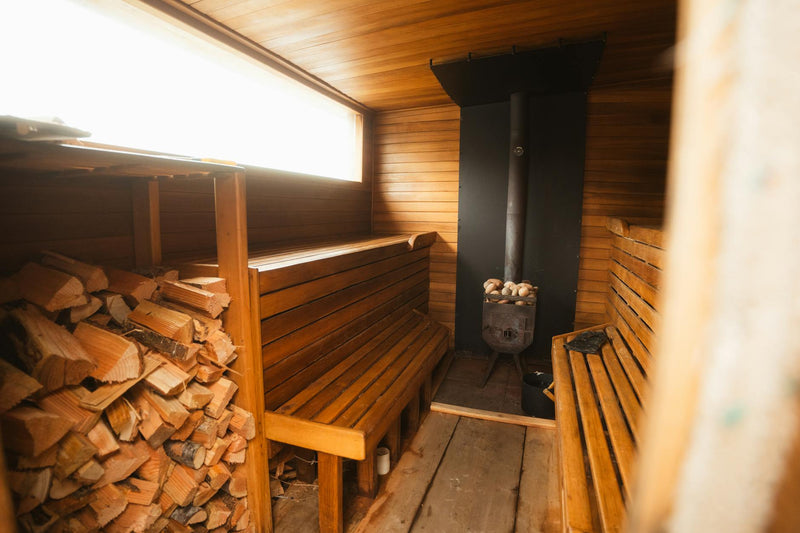
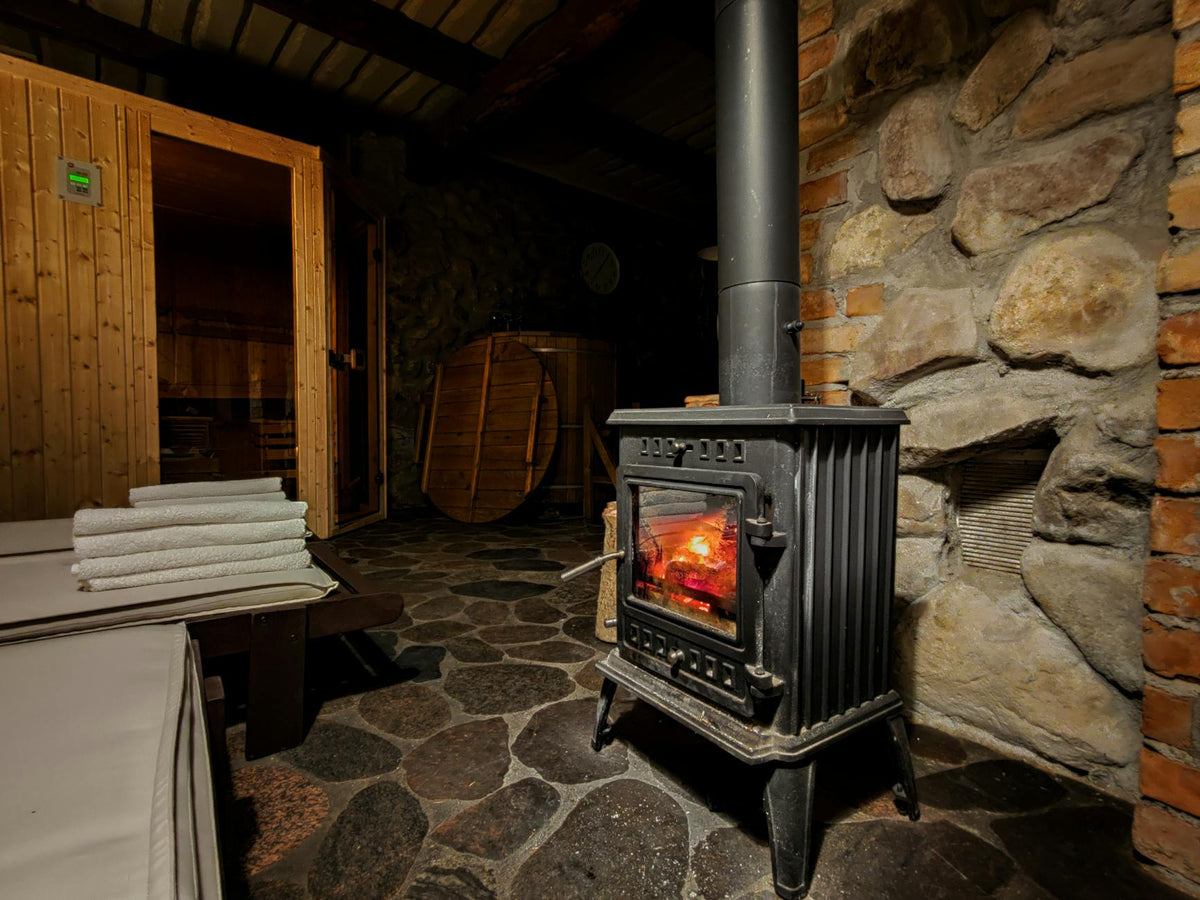
A wood-fired stove is a welded-steel firebox with a large stone cage above and a flue connection at the rear or top. Thermal output runs 12-24 kW. Heat-up time is 45-75 minutes from cold start. Radiant heat off the stove body is greater than from an electric heater of equivalent thermal output, contributing to the stronger löyly response valued in traditional Finnish bathing.
Flue, fuel and UK regulatory constraints
A wood-fired stove requires a twin-wall insulated flue (typically 125 mm internal diameter), HETAS-installed to Building Regulations Approved Document J, terminating at a height that complies with the manufacturer's instructions and the property's surroundings [5]. Inside a Smoke Control Area under the Clean Air Act 1993, only Defra-exempt appliances may be used, burning ready-to-burn certified kiln-dried hardwood at ≤20% moisture. Full treatment of the wood-fired regulatory framework is in wood-fired versus electric outdoor saunas.
Infrared heater arrays
Carbon, ceramic and full-spectrum emitters
Infrared heaters use one or more of three emitter types. Carbon panels are large-surface low-temperature emitters that produce even far-infrared coverage; the lower surface temperature is more comfortable to be near. Ceramic rods are smaller, hotter spot emitters with faster perceived warmth and tighter beam patterns. Full-spectrum heaters combine far-infrared with near-infrared LED panels for photobiomodulation applications. The infrared modality operates at 45-60°C cabin temperature without stones or water, so neither IEC 60335-2-53 in its strictest sauna-heater interpretation nor the kW-per-m³ rule applies in the same form.
Sizing in W per occupant rather than kW per m³
| Cabin size | Persons | Typical emitter power |
|---|---|---|
| Compact corner | 1 | 1.5 kW |
| Two-person | 2 | 2.0-2.4 kW |
| Three-person | 3 | 2.4-2.7 kW |
| Four-person | 4 | 2.6-3.0 kW |
Cabin volume matters less for infrared because the bather's body absorbs radiant energy directly, rather than the cabin air requiring full heating to deliver convective transfer to the bather.
Sizing, the kW-per-m³ rule of thumb
The traditional Finnish rule of thumb is approximately 1 kW per m³ of internal cabin volume for a well-insulated traditional sauna with a closed door, glass element ≤30% of one wall, and a ceiling at 2.0-2.1 m [4]. The rule applies to electric and wood-fired heaters alike. It does not apply to infrared cabins.
| Cabin volume | Recommended heater | Circuit |
|---|---|---|
| 2.5-4 m³ | 3.5 kW | 16 A |
| 4-6 m³ | 4.5 kW | 16 A |
| 6-9 m³ | 6 kW | 32 A |
| 9-12 m³ | 8 kW | 32 A |
| 12-15 m³ | 9 kW | 32 A |
| 15+ m³ | 10.5-15 kW (floor-standing) | 3-phase 16 A or 32 A |
Adjust upward by 10-15% for poorly insulated cabins, partial-glass cabins, or ceilings above 2.1 m.
Stones, type, capacity and replacement
Heater stones are peridotite (most common), olivine or mantle dunite, mineral types selected for low thermal expansion and resistance to thermal shock. Capacity drives thermal mass and löyly quality, the thermal reserve in the stones determines how the cabin recovers temperature after each pour.
| Heater class | Power | Stone capacity |
|---|---|---|
| Compact wall-mount | 3.5-4.5 kW | 20-30 kg |
| Mid wall-mount | 6-8 kW | 30-40 kg |
| Floor-standing | 9-15 kW | 60-100 kg |
| Wood-fired kiuas | 12-24 kW thermal | 30-80 kg |
Replacement is at 12-24 months for typical home use. Stones must be replaced immediately if they fracture, accumulate heavy mineral scale, or settle into the element zone. Stones that have lost their original angular shape no longer pack with the gaps needed for airflow and reduce heating efficiency. Replacement stones must be peridotite, olivine or mantle dunite from a sauna supplier, domestic gravel or rounded river stones are not safe in a heater.
Controller types, built-in, external, wifi
| Feature | Built-in dial | External wall pad | Wifi-enabled |
|---|---|---|---|
| Pre-heat from outside cabin | No | Yes | Yes (remote) |
| Timer / scheduling | Limited | Yes | Yes |
| Phone app integration | No | No | Yes |
| Cost premium | None (baseline) | £100-£250 | £200-£500 |
| Install complexity | None | Wall pad cabling | Wall pad + network setup |
| Cloud / firmware dependency | No | No | Yes |
All three controller types operate the same underlying heater safety circuits. The wifi option adds remote preheat from a phone app and home-automation integration, at the cost of dependence on the manufacturer's cloud service and ongoing firmware support.
Safety, IEC 60335-2-53 and Approved Document P
IEC 60335-2-53 is the international safety standard covering household electric sauna heating appliances [1]. The standard defines:
- Over-temperature cut-out, operating at 140°C cabin air to disconnect the supply.
- Maximum contact-surface temperature on the heater body.
- Minimum clearance distances from combustibles (walls, bench framing, ceiling).
- Test methods for the above.
A compliant heater is the baseline for legal sale and installation in the UK; the standard is referenced in the manufacturer's declaration of conformity and the user manual.
UK installation certification follows Building Regulations Approved Document P [2]. Sauna heater circuits are notifiable work; the circuit must be installed by a Part P registered electrician (NICEIC, NAPIT, ELECSA) and signed off with an Electrical Installation Certificate covering BS 7671:2018+A2:2022 [3]. A 30 mA RCD is mandatory under BS 7671. Equivalent rules apply in Scotland (Building Standards) and Northern Ireland (Building Regulations Part E). The certificate is retained for the buildings insurer.
Longevity, maintenance and replacement
| Heater type | Service life | Typical end-of-life event |
|---|---|---|
| Electric wall-mount | 8-15 years (6,000-10,000 h) | Element failure |
| Electric floor-standing | 10-15 years | Element failure or chassis corrosion |
| Wood-fired stove | 15-25 years | Firebox warpage; gasket failure (3-5 yr replacement) |
| Infrared carbon panel | 5-10 years | Linear output degradation |
| Infrared ceramic rod | 5-10 years | Element failure |
Electric heater elements degrade with cumulative hours at full draw; element replacement is sometimes economic on higher-end heaters. Wood-fired stoves accept gasket replacement and reline; the firebox itself lasts the service life given normal use. Infrared carbon panels degrade more linearly than ceramic rods, with intensity falling progressively rather than ending in a binary failure. Replacement intervals for the outdoor heater context are detailed in the outdoor sauna buyer's guide.
Frequently asked questions
What kind of sauna heater is needed for a UK home?
Choice depends on cabin volume, location and electrical supply. A 4 m³ cabin (2 × 2 × 2 m) needs a 4.5 kW electric heater on a 16 A circuit. A 6 m³ cabin needs 6 kW on a 32 A circuit. Wood-fired stoves are the right choice off-grid or where local rules permit; electric is the right choice indoors or in Smoke Control Areas. Infrared arrays are sized per occupant, typically 1.5 kW (1-person), 2.4 kW (2-person), or 3.0 kW (4-person).
How big a sauna heater is needed for a 6 m³ cabin?
A 6 m³ cabin (for example 2 × 2 × 1.5 m, or 2 × 1.5 × 2 m) needs a 6 kW traditional Finnish heater under the 1 kW-per-m³ rule of thumb. The heater requires a dedicated 32 A hardwired circuit installed under Approved Document P. Allow +10-15% (a 7 kW or 8 kW heater) if the cabin has a partial-glass wall, sits against an external uninsulated wall, or has a ceiling above 2.1 m.
What is the kW-per-m³ rule for sauna heaters?
The Finnish rule of thumb is approximately 1 kW per m³ of internal cabin volume for a well-insulated traditional sauna with a closed door and a ceiling at 2.0-2.1 m. The rule applies to electric and wood-fired heaters alike. It does not apply to infrared cabins, radiant energy reaches the bather directly, so sizing is per occupant rather than per m³. Adjust upward by 10-15% for poorly insulated cabins or large glass elements.
How many stones does a sauna heater hold?
Stone capacity rises with heater power. A compact 4.5 kW wall-mounted heater holds 20-30 kg of peridotite or olivine. A 6 kW heater holds 30-40 kg. A 9 kW floor-standing heater holds 60-100 kg. Greater stone mass produces a softer, longer-lasting löyly response when water is thrown onto the stones, the thermal reserve in the stones determines how the cabin recovers temperature after each pour.
What is the IEC 60335-2-53 standard?
IEC 60335-2-53 is the international safety standard covering household electric sauna heating appliances. It defines the over-temperature cut-out (operating at 140°C cabin air), minimum clearance distances from combustibles, the maximum permissible contact-surface temperature on the heater body, and test methods. A compliant heater is the baseline for legal sale and installation in the UK; the standard is referenced in the manufacturer's declaration of conformity and the user manual.
Does a sauna heater install need certification?
Yes. In England and Wales, sauna heater circuits are notifiable work under Building Regulations Approved Document P. The circuit must be installed by a Part P registered electrician (NICEIC, NAPIT, ELECSA) and signed off with an Electrical Installation Certificate covering BS 7671:2018+A2:2022. A 30 mA RCD is mandatory. Equivalent rules apply in Scotland (Building Standards) and Northern Ireland (Building Regulations Part E). Retain the certificate for buildings insurance.
What controller type is best?
A built-in dial is the simplest and lowest-cost option. An external wall pad provides timer and temperature scheduling from outside the cabin. A wifi-enabled controller adds remote preheat from a phone app and integration with home automation systems. The trade-off is dependence on a manufacturer cloud and longer-term firmware support. All three controller types operate the same underlying heater safety circuits.
How often should sauna stones be replaced?
Every 12-24 months for home use at two to three sessions per week. Inspect annually for fractured stones, heavy mineral-scale build-up, or stones that have settled into the element zone. Stones that have lost their original angular shape no longer pack with the gaps needed for airflow and reduce heating efficiency. Replacement stones must be peridotite, olivine or mantle dunite from a sauna supplier, domestic gravel is not safe.
References
- IEC 60335-2-53. Household and similar electrical appliances (Safety) Particular requirements for electric sauna heating appliances. (S024)
- UK Building Regulations. Approved Document P (Electrical Safety, Dwellings, 2013 ed.). (S016)
- IET. BS 7671:2018+A2:2022 Wiring Regulations. (S017)
- Sauna Society of Finland. Technical bulletin on cabin construction and heater integration (Aapa Sauna 2018). (S018)
- HETAS. Domestic Combustion Compliance Guide; Approved Document J twin-wall flue installation. (Brief flags as non-S source, controlling UK regulation.)